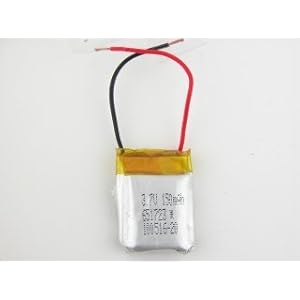
3.7V Li-po Battery for SYMA S107 Original Factory Replacement Part S107G-19
Item Description
Has your Helicopter lost it is power. Will it no longer hold a Charge. This is a Factory Replacement 3.7v Li-Po Battery. Light Soldering is Required.
Product Details
- Shipping Weight: 1 ounces (View shipping rates and policies)
- ASIN: B004KGTM90
- Amazon Best Sellers Rank: 719 in Toys ; Games (See Top 100 in Toys ; Games)
- 2 inToys ; Games Hobbies Radio Control Parts
By : Syma
Price : $5.40

Product Characteristics
- 3.7v 150 mAh LI-Po Battery
- Original Factory Replacement
- In no way leave a Charging Battery Unattended
Buyer Reviews
I bought this battery to execute some experiments with raising my flying time. This worked wonderful. I now average about 15-16 minutes flying time, and that is just till is begins to get a small weak. I could effortlessly go one other couple of minutes, but I don't want to push the batteries that tricky, and it's a lot extra enjoyable flying with charged batteries.
This modification is protected and quick. This is due to the fact these cells use security circuits to limit more than discharge and over charge. There are a few precautions even though:
1. Use two batteries of equal age. This means a new battery in a new heli and a new replacement battery, or two new replacement batteries. Do not mix a new replacement battery with an old, worn out battery.
two. Use two batteries of equal charge - preferably discharged. This is not important, but it is improved to start with two discharged batteries so they don't have any considerable energy if you accidentally brief some thing. Also, it just keeps every little thing in superior balance from the get started.
three. Hook up the batteries in parallel - red to red and black to black. This doubles the battery capacity and increases the flying time. If you hook them up in series (finish to finish), you will double the voltage, which will burn out the motors if it does not fry the heli's circuit board (and you will not be in a position to charge them anyway).
This is how you make the modification. 1st, the new battery is possibly completely discharged, so fly your heli till the battery is discharged (unless you are working with two new cells). Then splice the new battery in parallel with the battery in the heli. I located it easiest to just cut out the existing battery, leaving about equal lengths of red and black wire. Then I trimmed the wires on the new battery to the same length. I then stripped and tinned all the wire ends. I then soldered the two batteries together, red to red and black to black. Using the double sided tape that held in the old battery, I stuck them together. I then slid some heat shrink more than the wires coming from the heli. I then lap soldered the battery wires to the heli wires, red to red and black to black. I then slid up the heat shrink over the solder joint and shrunk it. You could also wrap the wires together and cover them with tape, but that is most likely harder in the restricted space, and they will not hold as properly as solder. Then I removed the weight taped in the nose of the canopy. Lastly, you just locate the battery more than the battery holder (see photo) and slide on the canopy - it really is a snug fit, so there is no require to tape down the battery.
With this straight forward modification, you will double your flying time - or alot more. Each and every battery has half the present becoming drawn from it, so they retain a greater voltage for a longer time. It's like the initially minute or two with a single battery, but for ten-12 minutes. Depending on how tricky you fly, even soon after 14-15 minutes, you can nevertheless fly up to the ceiling. Right after about 15-16 minutes, I begin to discover that the heli is losing trim and it is harder to preserve lift. I could readily maintain going yet another couple of minutes, even flying in ground effect, but why push the batteries that tough. The down side is that it would probably take three hours to recharge applying the USB cable charger. So as an alternative, I'm applying the wall plug charger that takes about 1.five hours or less to fully charge the battery. The heli is also a little nose heavy, but I like that, and lots of consumers add nose weights anyway. With the heavy nose, you usually have forward momentum, and I feel it's much easier to manage. You can also go honestly quick in the forward direction, but very slow backwards and you cannot truly hover. You can also add counter weights to the tail (like the weight from the nose) if you do not like it.
Some other notes on battery life:
1. I estimate that the heli draws about 1.2A to keep altitude.
2. Full throttle draws about 1.5A max with a completely charged battery, but commonly about 1.35-1.4A.
three. Operating the tail motor draws yet another .2-.25A.
4. The LED only draws about 12mA, or only 1% of your typical current.
So you see, if you just maintain altitude, drift forward, and only turn appropriate and left, you only draw abut 1.2A. But if you are constantly zipping up and down and forward and backward, you are drawing about 1.65A. I'm quite possibly someplace in the middle and I get a decent 15-16 minutes. Your results may well differ.
-Cheers
This was a replacement battery for a Syma 107 that had over 100 flights. Hope
the new one lasts as long. Important point, with these batteries let them cool prior to
and following charging.
Related Product


Post a Comment