Showing posts with label B004IBPQEW. Show all posts

SYMA S108G 3.5 CH Infrared Mini Radio Controlled Marine Cobra Helicopter

Item Description


This is the Newest Mini Helicopter by Syma. The Electric Co-axial Micro helicopter series is suited for both the newbie and the advance pilot, everyone can get pleasure from it with the 1st flight.SYMA S108G 3.5 CH Infrared Mini Radio Controlled Marine Cobra Helicopter Gyro

Product Details

  • Product Dimensions: 8 x 3 x 2 inches ; 1 pounds
  • Shipping Weight: 2 pounds (View shipping rates and policies)
  • ASIN: B004IBPQEW
  • Item model number: S108G
  • Manufacturer recommended age: 14 years and up
  • Amazon Best Sellers Rank: 129 in Toys ; Games (See Top 100 in Toys ; Games)
  • 11 inToys ; Games Hobbies Radio Control Helicopters

By : Syma
Price : $22.35
SYMA S108G 3.5 CH Infrared Mini Radio Controlled Marine Cobra Helicopter Gyro

Product Functions

  • Mini Marine Cobra remote manage helicopter
  • Suitable for the beginner or advanced pilot
  • Deigned to fly up, down, left, proper, forward and backwards
  • Has about a ten meter control distance

Client Critiques


I personal 4 SYMA helos and they all have different characteristics.
1st, I bought a red S107G for 22$ and was blown away. But, immediately after a multitude of crashes connected to hitting the ceiling my initial a single was starting to show put on (rotor blades dented/chiped, broken canopy brace, led not centered, vertical stabilizer cracked awaiting it next crash to come off) within one week.
Second, I bought a second 107G and it came as yellow. The initial thing I noticed was the yellow 1, whilst totally identical other than color, was a lot a lot more potent and battery lasted longer. As a result, it was much more fun and way more hard to fly than red.
Third, getting that I am former active duty helocopter mechanic (CH-53a,d,e, T64-GE-416) for the Marines, I purchased the S108G (Cobra). People, the Cobra is a fully numerous helo all together. The collective (vertical manage) is not spring loaded like the S107G. Not only that, the Cobra is considerably additional robust in its response and power and can be tough to manage. This is troublesome to me as the Cobra's body and frame appears to be entirely plastic (as apposed to the S107 having a metal frame). Also, the Cobra has a single solid white light which I prefer to the flashing blue and red o the S107G. Simply because the collective is not spring loaded you can make it hover and set the controls down on a table it still flies. Oftentimes I forget to return the collective to zero when I crash. The Cobra has lost reception a few times and when it does it falls from the air and crashes. The Cobra appears to "Pop and Click" like a Marine will need to--no kidding. It can speed about space much more quickly than the other people and turns a lot much more speedily. In reality, the other seems sluggish in comparison and it is straightforward to "oversteer."
Forth, I also required to satisfy my curiousity associated to S109 (Apache). I have located the S109 is less difficult than all to fly. It also has two white leds rather than the flashing blue and red of the S107G. The controller is the very same as the S107. Overall, I extremely get it enjoyable to reliably fly about the room with total and utter control. I think they did this to maintain the Army from crashing out of control--just kidding solders!
Bottom line, I give the S109 top rating over the others. I do find the responsivness and speed of the Cobra stimulating and of interest so I rate it second. If I fly with somebody else I will select the Cobra for its speed and responsivenees. In the finish, I don't assume the metal frame of the S107G will add much worth as the rest of the helo is plastic and does break. The cost of replacement parts can't be justified as a new S107G presently goes for 22$.

This helicopter flew really well - for a while.
Syma makes a number of quite slick tiny helicopters - I have purchased quite a few different models for the nephews and relatives, and every person loves them. This helicopter, the cobra, looks great and flew incredibly nicely. All of the Symas we tried so far fly very nicely out of the box. The Blackhawk and Chinook flew fairly well. The challenge with this particular (Cobra) helicopter is the landing gear. After a few crashes, the strut on 1 of the landing gear broke, meaning that on the ground, the helicopter won't stand up perfectly straight. No significant deal - right? Wrong. If the helicopter is not standing up straight, it won't take off straight, and will possibly crash into a thing before it stabilizes. The Blackhawk and Chinook have several landing gear which are a lot more durable.
For those of you who are 1st time pilots, focus on hovering for your 1st few flights. Just tweak the controls to try and keep the helicopter in 1 spot. If you can master hovering, the rest gets a lot simpler.
Syma's mini helicopters are only for indoor use. The dilemma with flying them outdoors is wind - the smallest puff of a breeze makes the helicpters uncontrolable.
For those of you who do not know significantly about Syma's RC helicopters, here is how they function:
1. Stabilization: For true helicopters, the tail rotor controls rotation. With no a tail rotor, a genuine helicopter would be unable to turn, and would essentially spin out of manage. The motor for the main rotor wants to spin the fuselage in the opposite direction of the rotation of the primary propeller. Consider about it - if you had been to magically "hold" the propeller in place, the fuselage would spin. The motor of a usual helicopter, if left unchecked, would spin the propeller and the fuselage in opposite directions. In authentic helicopters, the tail rotor counteracts the rotational force that the most important rotor applies to the fuselage
With Syma's helicopters (other than the Chinook), they essentially have 2 most important propellers stacked on top of every single other that have blades that are angled differently, and spin in opposite directions. Each propellers produce down force, but also create torque on the fuselage in opposite directions. This has the impact of keeping the helicopter stable, because the rotational forces of the two propellers on the fuselage cancel each other out. Syma's remote controllers come with a "Trim" control knob. This manage is applied to make confident that the 2 primary propellers are spinning at the similar RPM. If your helicopter's fuselage spins slightly on takeoff, use the trim knob to correct it up.
two. Turning: In order to turn, Syma's helicopters slow down one particular of the main rotors by a small amount, basically applying the forces described in 1 to rotate the fuselage. Turning for all of Syma's helicopters is really precise once you have them trimmed.
three. Forward/Backward motion - this is controlled by the horizontally aligned tail rotor. To go forward, the tail rotor spins, producing down force, which pushes the tail up. When the tail is up, the main rotors are angled slightly backwards, so the principal rotor pushes the helicopter forward. Reverse has the opposite effect. The tail prop pushes the tail down, which angles the thrust of the principal rotors slightly forward, which pushes the helicopter backward.
4. Sideways motion (Yaw)- Syma's helicopters do not have any mechanism for tilting the helicopter's roto sideways, so the helicopters have no potential to move side to side. In genuine helicopters, the primary rotor tilts forward/backward, left and appropriate, and this gives the ability for the helicopter to move in pretty substantially any direction.
This Cobra heli is not as stable in flight as the Chinook or the Blackhawk. It just appears like the helicopter is a tiny also responsive.
In brief, if you are a great pilot, and won't crash, this helicopter is just fine. For my taste, even though, the Blackhawk and Chinook are much more durable and easier to fly.
One other note - Really Crucial! This helicopter comes with an further tail rotor in a plastic baggie. Save it, and put it in a secure place. The tail rotor controls forward and backward motion, and if you shed your tail prop, all you can do is hover.
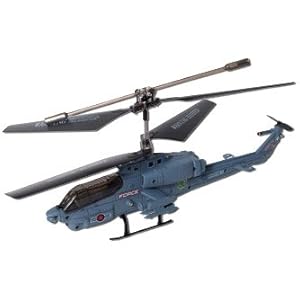
SYMA S108G 3.5 CH Infrared Mini Radio Controlled Marine Cobra Helicopter

Product Description


This is the Newest Mini Helicopter by Syma. The Electric Co-axial Micro helicopter series is suited for both the newbie and the advance pilot, any individual can take pleasure in it with the initial flight.SYMA S108G 3.5 CH Infrared Mini Radio Controlled Marine Cobra Helicopter Gyro

Product Details

  • Product Dimensions: 8 x 3 x 2 inches ; 1 pounds
  • Shipping Weight: 2 pounds (View shipping rates and policies)
  • ASIN: B004IBPQEW
  • Item model number: S108G
  • Manufacturer recommended age: 14 years and up
  • Amazon Best Sellers Rank: 114 in Toys ; Games (See Top 100 in Toys ; Games)
  • 11 inToys ; Games Hobbies Radio Control Helicopters

By : Syma
Price : $22.72
SYMA S108G 3.5 CH Infrared Mini Radio Controlled Marine Cobra Helicopter Gyro

Item Functions

  • Mini Marine Cobra remote manage helicopter
  • Suitable for the newbie or advanced pilot
  • Deigned to fly up, down, left, right, forward and backwards
  • Has about a ten meter manage distance

Customer Critiques


I personal 4 SYMA helos and they all have numerous characteristics.
Initial, I bought a red S107G for 22$ and was blown away. However, right after a multitude of crashes related to hitting the ceiling my first one was starting to show put on (rotor blades dented/chiped, broken canopy brace, led not centered, vertical stabilizer cracked awaiting it next crash to come off) inside one week.
Second, I bought a second 107G and it came as yellow. The 1st thing I noticed was the yellow one particular, though entirely identical other than color, was a lot a lot more effective and battery lasted longer. As a result, it was a great deal more enjoyable and way more tricky to fly than red.
Third, becoming that I am former active duty helocopter mechanic (CH-53a,d,e, T64-GE-416) for the Marines, I bought the S108G (Cobra). People, the Cobra is a entirely diverse helo all together. The collective (vertical control) is not spring loaded like the S107G. Not only that, the Cobra is much far more robust in its response and power and can be tricky to manage. This is troublesome to me as the Cobra's body and frame appears to be absolutely plastic (as apposed to the S107 getting a metal frame). Also, the Cobra has 1 solid white light which I prefer to the flashing blue and red o the S107G. Because the collective is not spring loaded you can make it hover and set the controls down on a table it still flies. Occasionally I forget to return the collective to zero when I crash. The Cobra has lost reception many occasions and when it does it falls from the air and crashes. The Cobra appears to "Pop and Click" like a Marine ought to--no kidding. It can speed around space much more rapidly than the other individuals and turns a lot a lot more swiftly. In reality, the other seems sluggish in comparison and it is uncomplicated to "oversteer."
Forth, I also required to satisfy my curiousity related to S109 (Apache). I have located the S109 is much easier than all to fly. It also has two white leds rather than the flashing blue and red of the S107G. The controller is the same as the S107. Overall, I truly discover it enjoyable to reliably fly about the room with full and utter control. I feel they did this to keep the Army from crashing out of manage--just kidding solders!
Bottom line, I give the S109 leading rating over the others. I do discover the responsivness and speed of the Cobra stimulating and of interest so I rate it second. If I fly with somebody else I will pick the Cobra for its speed and responsivenees. In the end, I do not feel the metal frame of the S107G will add considerably worth as the rest of the helo is plastic and does break. The expense of replacement components cannot be justified as a new S107G currently goes for 22$.

This helicopter flew particularly properly - for a whilst.
Syma tends to make a quantity of particularly slick small helicopters - I have bought a variety of distinctive models for the nephews and relatives, and everyone loves them. This helicopter, the cobra, looks very good and flew particularly properly. All of the Symas we tried so far fly incredibly nicely out of the box. The Blackhawk and Chinook flew rather nicely. The challenge with this particular (Cobra) helicopter is the landing gear. Soon after a handful of crashes, the strut on 1 of the landing gear broke, meaning that on the ground, the helicopter won't stand up perfectly straight. No big deal - right? Wrong. If the helicopter isn't standing up straight, it won't take off straight, and will quite possibly crash into something just before it stabilizes. The Blackhawk and Chinook have diverse landing gear which are way more durable.
For those of you who are 1st time pilots, concentrate on hovering for your very first handful of flights. Just tweak the controls to attempt and maintain the helicopter in 1 spot. If you can master hovering, the rest gets a lot easier.
Syma's mini helicopters are only for indoor use. The trouble with flying them outdoors is wind - the smallest puff of a breeze makes the helicpters uncontrolable.
For those of you who do not know a lot about Syma's RC helicopters, here is how they function:
1. Stabilization: For real helicopters, the tail rotor controls rotation. With out a tail rotor, a actual helicopter would be unable to turn, and would really spin out of control. The motor for the key rotor wants to spin the fuselage in the opposite direction of the rotation of the primary propeller. Assume about it - if you had been to magically "hold" the propeller in place, the fuselage would spin. The motor of a typical helicopter, if left unchecked, would spin the propeller and the fuselage in opposite directions. In genuine helicopters, the tail rotor counteracts the rotational force that the principal rotor applies to the fuselage
With Syma's helicopters (other than the Chinook), they really have 2 key propellers stacked on top rated of each and every other that have blades that are angled differently, and spin in opposite directions. Both propellers offer down force, but also produce torque on the fuselage in opposite directions. This has the impact of keeping the helicopter stable, considering that the rotational forces of the two propellers on the fuselage cancel each other out. Syma's remote controllers come with a "Trim" control knob. This manage is utilized to make confident that the two key propellers are spinning at the same RPM. If your helicopter's fuselage spins slightly on takeoff, use the trim knob to correct it up.
2. Turning: In order to turn, Syma's helicopters slow down a single of the key rotors by a compact amount, basically employing the forces described in 1 to rotate the fuselage. Turning for all of Syma's helicopters is quite precise once you have them trimmed.
three. Forward/Backward motion - this is controlled by the horizontally aligned tail rotor. To go forward, the tail rotor spins, making down force, which pushes the tail up. When the tail is up, the principal rotors are angled slightly backwards, so the most important rotor pushes the helicopter forward. Reverse has the opposite effect. The tail prop pushes the tail down, which angles the thrust of the key rotors slightly forward, which pushes the helicopter backward.
4. Sideways motion (Yaw)- Syma's helicopters don't have any mechanism for tilting the helicopter's roto sideways, so the helicopters have no capacity to move side to side. In true helicopters, the key rotor tilts forward/backward, left and correct, and this delivers the capacity for the helicopter to move in quite significantly any direction.
This Cobra heli is not as stable in flight as the Chinook or the Blackhawk. It just appears like the helicopter is a small also responsive.
In short, if you are a beneficial pilot, and won't crash, this helicopter is just fine. For my taste, although, the Blackhawk and Chinook are additional durable and less complicated to fly.
One other note - Really Very important! This helicopter comes with an further tail rotor in a plastic baggie. Save it, and put it in a secure spot. The tail rotor controls forward and backward motion, and if you shed your tail prop, all you can do is hover.

SYMA S108G 3.5 CH Infrared Mini Radio Controlled Marine Cobra Helicopter

Product Description


This is the Newest Mini Helicopter by Syma. The Electric Co-axial Micro helicopter series is suited for both the beginner and the advance pilot, anyone can enjoy it with the first flight. SYMA S108G 3.5 CH Infrared Mini Radio Controlled Marine Cobra Helicopter Gyro

Product Details

  • Product Dimensions: 8 x 3 x 2 inches ; 1 pounds
  • Shipping Weight: 2 pounds (View shipping rates and policies)
  • ASIN: B004IBPQEW
  • Item model number: S108G
  • Manufacturer recommended age: 14 years and up
  • Amazon Best Sellers Rank: 102 in Toys ; Games (See Top 100 in Toys ; Games)
  • 10 inToys ; Games Hobbies Radio Control Helicopters

By : Syma
Price : $22.88
SYMA S108G 3.5 CH Infrared Mini Radio Controlled Marine Cobra Helicopter Gyro

Product Features

  • Mini Marine Cobra remote control helicopter
  • Suitable for the beginner or advanced pilot
  • Deigned to fly up, down, left, right, forward and backwards
  • Has about a 10 meter control distance

Customer Reviews


I own four SYMA helos and they all have different characteristics.
First, I purchased a red S107G for 22$ and was blown away. However, after a multitude of crashes related to hitting the ceiling my first one was beginning to show wear (rotor blades dented/chiped, broken canopy brace, led not centered, vertical stabilizer cracked awaiting it next crash to come off) within one week.
Second, I purchased a second 107G and it came as yellow. The first thing I noticed was the yellow one, while completely identical other than color, was much more powerful and battery lasted longer. As a result, it was more fun and more difficult to fly than red.
Third, being that I am former active duty helocopter mechanic (CH-53a,d,e, T64-GE-416) for the Marines, I bought the S108G (Cobra). Folks, the Cobra is a completely different helo all together. The collective (vertical control) is not spring loaded like the S107G. Not only that, the Cobra is much more robust in its response and power and can be difficult to manage. This is troublesome to me as the Cobra's body and frame appears to be completely plastic (as apposed to the S107 having a metal frame). Also, the Cobra has one solid white light which I prefer to the flashing blue and red o the S107G. Because the collective is not spring loaded you can make it hover and set the controls down on a table it still flies. Sometimes I forget to return the collective to zero when I crash. The Cobra has lost reception several times and when it does it falls from the air and crashes. The Cobra appears to "Pop and Click" like a Marine should--no kidding. It can speed around room much faster than the others and turns much more quickly. In fact, the other seems sluggish in comparison and it is easy to "oversteer."
Forth, I also needed to satisfy my curiousity related to S109 (Apache). I have found the S109 is easier than all to fly. It also has two white leds rather than the flashing blue and red of the S107G. The controller is the same as the S107. Overall, I really find it enjoyable to reliably fly around the room with complete and utter control. I think they did this to keep the Army from crashing out of control--just kidding solders!
Bottom line, I give the S109 top rating over the others. I do find the responsivness and speed of the Cobra stimulating and of interest so I rate it second. If I fly with someone else I will choose the Cobra for its speed and responsivenees. In the end, I don't think the metal frame of the S107G will add much value as the rest of the helo is plastic and does break. The cost of replacement parts cannot be justified as a new S107G currently goes for 22$.

This helicopter flew very well - for a while.
Syma makes a number of very slick little helicopters - I have bought several different models for the nephews and relatives, and everyone loves them. This helicopter, the cobra, looks good and flew very well. All of the Symas we tried so far fly extremely well out of the box. The Blackhawk and Chinook flew very well. The challenge with this particular (Cobra) helicopter is the landing gear. After a few crashes, the strut on 1 of the landing gear broke, meaning that on the ground, the helicopter won't stand up perfectly straight. No big deal - right? Wrong. If the helicopter isn't standing up straight, it won't take off straight, and will probably crash into something before it stabilizes. The Blackhawk and Chinook have different landing gear which are more durable.
For those of you who are first time pilots, focus on hovering for your first few flights. Just tweak the controls to try and keep the helicopter in 1 place. If you can master hovering, the rest gets a lot easier.
Syma's mini helicopters are only for indoor use. The problem with flying them outdoors is wind - the smallest puff of a breeze makes the helicpters uncontrolable.
For those of you who don't know much about Syma's RC helicopters, here is how they work:
1. Stabilization: For real helicopters, the tail rotor controls rotation. Without a tail rotor, a real helicopter would be unable to turn, and would actually spin out of control. The motor for the main rotor wants to spin the fuselage in the opposite direction of the rotation of the main propeller. Think about it - if you were to magically "hold" the propeller in place, the fuselage would spin. The motor of a normal helicopter, if left unchecked, would spin the propeller and the fuselage in opposite directions. In real helicopters, the tail rotor counteracts the rotational force that the main rotor applies to the fuselage
With Syma's helicopters (other than the Chinook), they actually have 2 main propellers stacked on top of each other that have blades that are angled differently, and spin in opposite directions. Both propellers provide down force, but also produce torque on the fuselage in opposite directions. This has the effect of keeping the helicopter stable, since the rotational forces of the 2 propellers on the fuselage cancel each other out. Syma's remote controllers come with a "Trim" control knob. This control is used to make sure that the 2 main propellers are spinning at the same RPM. If your helicopter's fuselage spins slightly on takeoff, use the trim knob to true it up.
2. Turning: In order to turn, Syma's helicopters slow down one of the main rotors by a small amount, essentially using the forces described in 1 to rotate the fuselage. Turning for all of Syma's helicopters is very precise once you have them trimmed.
3. Forward/Backward motion - this is controlled by the horizontally aligned tail rotor. To go forward, the tail rotor spins, producing down force, which pushes the tail up. When the tail is up, the main rotors are angled slightly backwards, so the main rotor pushes the helicopter forward. Reverse has the opposite effect. The tail prop pushes the tail down, which angles the thrust of the main rotors slightly forward, which pushes the helicopter backward.
4. Sideways motion (Yaw)- Syma's helicopters don't have any mechanism for tilting the helicopter's roto sideways, so the helicopters have no ability to move side to side. In real helicopters, the main rotor tilts forward/backward, left and right, and this provides the ability for the helicopter to move in pretty much any direction.
This Cobra heli is not as stable in flight as the Chinook or the Blackhawk. It just seems like the helicopter is a little too responsive.
In short, if you are a good pilot, and won't crash, this helicopter is just fine. For my taste, though, the Blackhawk and Chinook are more durable and easier to fly.
One other note - VERY IMPORTANT! This helicopter comes with an additional tail rotor in a plastic baggie. Save it, and put it in a safe place. The tail rotor controls forward and backward motion, and if you lose your tail prop, all you can do is hover.

SYMA S108G 3.5 CH Infrared Mini Radio Controlled Marine Cobra Helicopter

Product Description


This is the Newest Mini Helicopter by Syma. The Electric Co-axial Micro helicopter series is suited for both the beginner and the advance pilot, anyone can enjoy it with the first flight. SYMA S108G 3.5 CH Infrared Mini Radio Controlled Marine Cobra Helicopter Gyro

Product Details

  • Product Dimensions: 8 x 3 x 2 inches ; 1 pounds
  • Shipping Weight: 2 pounds (View shipping rates and policies)
  • ASIN: B004IBPQEW
  • Item model number: S108G
  • Manufacturer recommended age: 14 years and up
  • Amazon Best Sellers Rank: 95 in Toys ; Games (See Top 100 in Toys ; Games)
  • 12 inToys ; Games Hobbies Radio Control Helicopters

By : Syma
Price : $22.99
SYMA S108G 3.5 CH Infrared Mini Radio Controlled Marine Cobra Helicopter Gyro

Product Features

  • Mini Marine Cobra remote control helicopter
  • Suitable for the beginner or advanced pilot
  • Deigned to fly up, down, left, right, forward and backwards
  • Has about a 10 meter control distance

Customer Reviews


I own four SYMA helos and they all have different characteristics.
First, I purchased a red S107G for 22$ and was blown away. However, after a multitude of crashes related to hitting the ceiling my first one was beginning to show wear (rotor blades dented/chiped, broken canopy brace, led not centered, vertical stabilizer cracked awaiting it next crash to come off) within one week.
Second, I purchased a second 107G and it came as yellow. The first thing I noticed was the yellow one, while completely identical other than color, was much more powerful and battery lasted longer. As a result, it was more fun and more difficult to fly than red.
Third, being that I am former active duty helocopter mechanic (CH-53a,d,e, T64-GE-416) for the Marines, I bought the S108G (Cobra). Folks, the Cobra is a completely different helo all together. The collective (vertical control) is not spring loaded like the S107G. Not only that, the Cobra is much more robust in its response and power and can be difficult to manage. This is troublesome to me as the Cobra's body and frame appears to be completely plastic (as apposed to the S107 having a metal frame). Also, the Cobra has one solid white light which I prefer to the flashing blue and red o the S107G. Because the collective is not spring loaded you can make it hover and set the controls down on a table it still flies. Sometimes I forget to return the collective to zero when I crash. The Cobra has lost reception several times and when it does it falls from the air and crashes. The Cobra appears to "Pop and Click" like a Marine should--no kidding. It can speed around room much faster than the others and turns much more quickly. In fact, the other seems sluggish in comparison and it is easy to "oversteer."
Forth, I also needed to satisfy my curiousity related to S109 (Apache). I have found the S109 is easier than all to fly. It also has two white leds rather than the flashing blue and red of the S107G. The controller is the same as the S107. Overall, I really find it enjoyable to reliably fly around the room with complete and utter control. I think they did this to keep the Army from crashing out of control--just kidding solders!
Bottom line, I give the S109 top rating over the others. I do find the responsivness and speed of the Cobra stimulating and of interest so I rate it second. If I fly with someone else I will choose the Cobra for its speed and responsivenees. In the end, I don't think the metal frame of the S107G will add much value as the rest of the helo is plastic and does break. The cost of replacement parts cannot be justified as a new S107G currently goes for 22$.

This helicopter flew very well - for a while.
Syma makes a number of very slick little helicopters - I have bought several different models for the nephews and relatives, and everyone loves them. This helicopter, the cobra, looks good and flew very well. All of the Symas we tried so far fly extremely well out of the box. The Blackhawk and Chinook flew very well. The challenge with this particular (Cobra) helicopter is the landing gear. After a few crashes, the strut on 1 of the landing gear broke, meaning that on the ground, the helicopter won't stand up perfectly straight. No big deal - right? Wrong. If the helicopter isn't standing up straight, it won't take off straight, and will probably crash into something before it stabilizes. The Blackhawk and Chinook have different landing gear which are more durable.
For those of you who are first time pilots, focus on hovering for your first few flights. Just tweak the controls to try and keep the helicopter in 1 place. If you can master hovering, the rest gets a lot easier.
Syma's mini helicopters are only for indoor use. The problem with flying them outdoors is wind - the smallest puff of a breeze makes the helicpters uncontrolable.
For those of you who don't know much about Syma's RC helicopters, here is how they work:
1. Stabilization: For real helicopters, the tail rotor controls rotation. Without a tail rotor, a real helicopter would be unable to turn, and would actually spin out of control. The motor for the main rotor wants to spin the fuselage in the opposite direction of the rotation of the main propeller. Think about it - if you were to magically "hold" the propeller in place, the fuselage would spin. The motor of a normal helicopter, if left unchecked, would spin the propeller and the fuselage in opposite directions. In real helicopters, the tail rotor counteracts the rotational force that the main rotor applies to the fuselage
With Syma's helicopters (other than the Chinook), they actually have 2 main propellers stacked on top of each other that have blades that are angled differently, and spin in opposite directions. Both propellers provide down force, but also produce torque on the fuselage in opposite directions. This has the effect of keeping the helicopter stable, since the rotational forces of the 2 propellers on the fuselage cancel each other out. Syma's remote controllers come with a "Trim" control knob. This control is used to make sure that the 2 main propellers are spinning at the same RPM. If your helicopter's fuselage spins slightly on takeoff, use the trim knob to true it up.
2. Turning: In order to turn, Syma's helicopters slow down one of the main rotors by a small amount, essentially using the forces described in 1 to rotate the fuselage. Turning for all of Syma's helicopters is very precise once you have them trimmed.
3. Forward/Backward motion - this is controlled by the horizontally aligned tail rotor. To go forward, the tail rotor spins, producing down force, which pushes the tail up. When the tail is up, the main rotors are angled slightly backwards, so the main rotor pushes the helicopter forward. Reverse has the opposite effect. The tail prop pushes the tail down, which angles the thrust of the main rotors slightly forward, which pushes the helicopter backward.
4. Sideways motion (Yaw)- Syma's helicopters don't have any mechanism for tilting the helicopter's roto sideways, so the helicopters have no ability to move side to side. In real helicopters, the main rotor tilts forward/backward, left and right, and this provides the ability for the helicopter to move in pretty much any direction.
This Cobra heli is not as stable in flight as the Chinook or the Blackhawk. It just seems like the helicopter is a little too responsive.
In short, if you are a good pilot, and won't crash, this helicopter is just fine. For my taste, though, the Blackhawk and Chinook are more durable and easier to fly.
One other note - VERY IMPORTANT! This helicopter comes with an additional tail rotor in a plastic baggie. Save it, and put it in a safe place. The tail rotor controls forward and backward motion, and if you lose your tail prop, all you can do is hover.

SYMA S108G 3.5 CH Infrared Mini Radio Controlled Marine Cobra Helicopter Gyro

SYMA S108G 3.5 CH Infrared Mini Radio Controlled Marine Cobra Helicopter Gyro

Product Details

  • Product Dimensions: 8 x 3 x 2 inches ; 1 pounds
  • Shipping Weight: 2 pounds (View shipping rates and policies)
  • ASIN: B004IBPQEW
  • Item model number: S108G
  • Manufacturer recommended age: 14 years and up
  • Amazon Best Sellers Rank: 67 in Toys ; Games (See Top 100 in Toys ; Games)
  • 12 inToys ; Games Hobbies Radio Control Helicopters

By : Syma
Price : $23.75
SYMA S108G 3.5 CH Infrared Mini Radio Controlled Marine Cobra Helicopter Gyro

Product Description

This is the Newest Mini Helicopter by SYMA. The Electric Co-axial Micro helicopter series is suited for both the bigginer and the advanceved pilot, anyone can enjoy it with the first flight.


Product Features

  • Feature: Up/down, left/ right,forward/backward
  • Battery: 3.7V 150Mah Li-poly
  • Charging time: About 35-45 mimutes (USB charging)
  • Flying time: About 6--8 minutes
  • Controlling distance: About 10 meters

Costumer Reviews

I own four SYMA helos and they all have different characteristics.

First, I purchased a red S107G for 22$ and was blown away. However, after a multitude of crashes related to hitting the ceiling my first one was beginning to show wear (rotor blades dented/chiped, broken canopy brace, led not centered, vertical stabilizer cracked awaiting it next crash to come off) within one week.

Second, I purchased a second 107G and it came as yellow. The first thing I noticed was the yellow one, while completely identical other than color, was much more powerful and battery lasted longer. As a result, it was more fun and more difficult to fly than red.

Third, being that I am former active duty helocopter mechanic (CH-53a,d,e, T64-GE-416) for the Marines, I bought the S108G (Cobra). Folks, the Cobra is a completely different helo all together. The collective (vertical control) is not spring loaded like the S107G. Not only that, the Cobra is much more robust in its response and power and can be difficult to manage. This is troublesome to me as the Cobra's body and frame appears to be completely plastic (as apposed to the S107 having a metal frame). Also, the Cobra has one solid white light which I prefer to the flashing blue and red o the S107G. Because the collective is not spring loaded you can make it hover and set the controls down on a table it still flies. Sometimes I forget to return the collective to zero when I crash. The Cobra has lost reception several times and when it does it falls from the air and crashes. The Cobra appears to "Pop and Click" like a Marine should--no kidding. It can speed around room much faster than the others and turns much more quickly. In fact, the other seems sluggish in comparison and it is easy to "oversteer."

Forth, I also needed to satisfy my curiousity related to S109 (Apache). I have found the S109 is easier than all to fly. It also has two white leds rather than the flashing blue and red of the S107G. The controller is the same as the S107. Overall, I really find it enjoyable to reliably fly around the room with complete and utter control. I think they did this to keep the Army from crashing out of control--just kidding solders!

Bottom line, I give the S109 top rating over the others. I do find the responsivness and speed of the Cobra stimulating and of interest so I rate it second. If I fly with someone else I will choose the Cobra for its speed and responsivenees. In the end, I don't think the metal frame of the S107G will add much value as the rest of the helo is plastic and does break. The cost of replacement parts cannot be justified as a new S107G currently goes for 22$.

This helicopter flew very well - for a while.

Syma makes a number of very slick little helicopters - I have bought several different models for the nephews and relatives, and everyone loves them. This helicopter, the cobra, looks good and flew very well. All of the Symas we tried so far fly extremely well out of the box. The Blackhawk and Chinook flew very well. The challenge with this particular (Cobra) helicopter is the landing gear. After a few crashes, the strut on 1 of the landing gear broke, meaning that on the ground, the helicopter won't stand up perfectly straight. No big deal - right? Wrong. If the helicopter isn't standing up straight, it won't take off straight, and will probably crash into something before it stabilizes. The Blackhawk and Chinook have different landing gear which are more durable.

For those of you who are first time pilots, focus on hovering for your first few flights. Just tweak the controls to try and keep the helicopter in 1 place. If you can master hovering, the rest gets a lot easier.

Syma's mini helicopters are only for indoor use. The problem with flying them outdoors is wind - the smallest puff of a breeze makes the helicpters uncontrolable.

For those of you who don't know much about Syma's RC helicopters, here is how they work:

1. Stabilization: For real helicopters, the tail rotor controls rotation. Without a tail rotor, a real helicopter would be unable to turn, and would actually spin out of control. The motor for the main rotor wants to spin the fuselage in the opposite direction of the rotation of the main propeller. Think about it - if you were to magically "hold" the propeller in place, the fuselage would spin. The motor of a normal helicopter, if left unchecked, would spin the propeller and the fuselage in opposite directions. In real helicopters, the tail rotor counteracts the rotational force that the main rotor applies to the fuselage

With Syma's helicopters (other than the Chinook), they actually have 2 main propellers stacked on top of each other that have blades that are angled differently, and spin in opposite directions. Both propellers provide down force, but also produce torque on the fuselage in opposite directions. This has the effect of keeping the helicopter stable, since the rotational forces of the 2 propellers on the fuselage cancel each other out. Syma's remote controllers come with a "Trim" control knob. This control is used to make sure that the 2 main propellers are spinning at the same RPM. If your helicopter's fuselage spins slightly on takeoff, use the trim knob to true it up.

2. Turning: In order to turn, Syma's helicopters slow down one of the main rotors by a small amount, essentially using the forces described in 1 to rotate the fuselage. Turning for all of Syma's helicopters is very precise once you have them trimmed.

3. Forward/Backward motion - this is controlled by the horizontally aligned tail rotor. To go forward, the tail rotor spins, producing down force, which pushes the tail up. When the tail is up, the main rotors are angled slightly backwards, so the main rotor pushes the helicopter forward. Reverse has the opposite effect. The tail prop pushes the tail down, which angles the thrust of the main rotors slightly forward, which pushes the helicopter backward.

4. Sideways motion (Yaw)- Syma's helicopters don't have any mechanism for tilting the helicopter's roto sideways, so the helicopters have no ability to move side to side. In real helicopters, the main rotor tilts forward/backward, left and right, and this provides the ability for the helicopter to move in pretty much any direction.

This Cobra heli is not as stable in flight as the Chinook or the Blackhawk. It just seems like the helicopter is a little too responsive.

In short, if you are a good pilot, and won't crash, this helicopter is just fine. For my taste, though, the Blackhawk and Chinook are more durable and easier to fly.

One other note - VERY IMPORTANT! This helicopter comes with an additional tail rotor in a plastic baggie. Save it, and put it in a safe place. The tail rotor controls forward and backward motion, and if you lose your tail prop, all you can do is hover.

Popular Posts

.

  © Copyright by Syma Mini Support By Automatically Posting from Amazon Content to Blogger

Back to TOP